
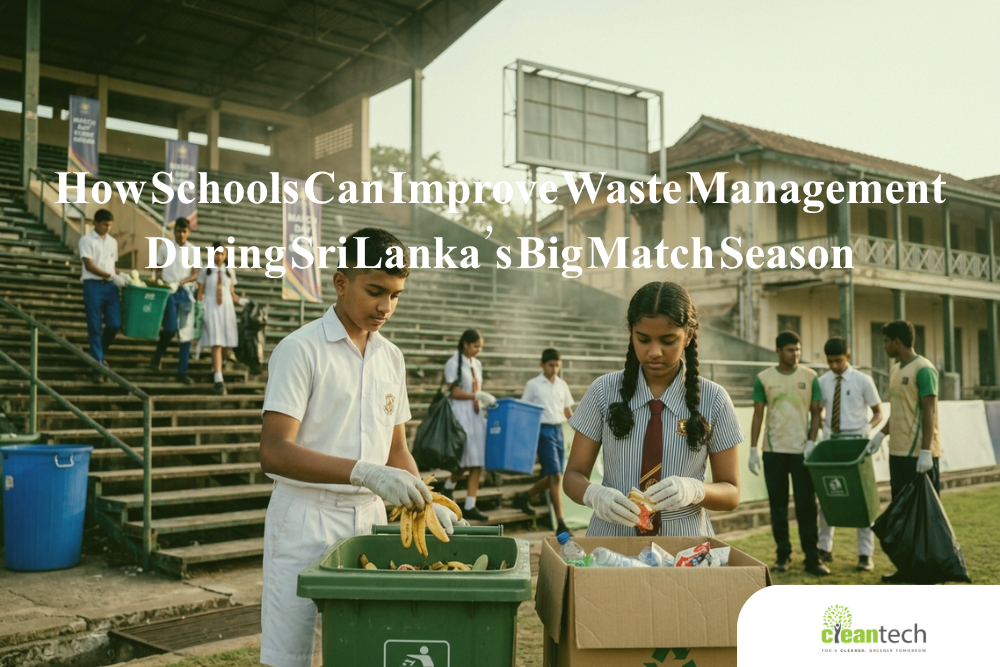
Big Match season in Sri Lanka… it’s kind of a big deal, honestly. The energy, the crowd, the traditions everything just comes together. Schools get packed, people come in large numbers, food stalls pop up everywhere. It’s exciting, no doubt.
But at the same time, there’s this other side we don’t always think about much waste. And not just a little bit. Plastic bottles, wrappers, leftover food… things start piling up pretty quickly.
That’s where things can get messy, literally. Still, if handled the right way, Schools Can Improve Waste Management without ruining the whole vibe of the event. It’s not about making things strict or boring, just… better managed, I guess.
Understanding Waste Challenges During Big Match Season
So the main issue is volume. On a normal school day, waste is manageable. But during Big Matches? It’s a completely different story.
You’ll see plastic cups, snack packets, decorations, sometimes even things people didn’t really need to bring in the first place. And once bins get full (which happens fast), people don’t always go looking for another one. They just leave things nearby. Not always on purpose, but still.
This is why understanding the problem matters first. If schools don’t really see how much waste is being created, it’s hard to control it. Once they do, though, Schools Can Improve Waste Management in ways that actually make sense.
Setting Up a Waste Management Plan Before the Event
Planning ahead sounds obvious, but it’s often rushed or skipped. And then everything feels chaotic later.
A simple plan is enough, really. Like estimating how much waste might be generated, deciding where bins should go, and who’s responsible for what. Even assigning small roles to students can help more than expected.
Also, coordinating with local waste collectors it’s one of those things people forget until it’s too late.
With just a bit of preparation, Schools Can Improve Waste Management without having to fix everything in a hurry later on.
Promoting Waste Segregation at Source
Now, this part is actually quite practical separating waste where it’s thrown. It sounds simple, and yeah, it kind of is.
Instead of mixing everything into one bin, schools can provide separate ones for different types of waste. The trick is making it easy. If it’s confusing, people won’t bother.
Bins should be placed where people actually need them, not hidden somewhere. And labels should be clear enough to understand in a second or two.
When done right, this is one of those steps where Schools Can Improve Waste Management without much extra effort.
Simple Segregation System for Schools
A basic system works best, honestly. Green for food waste, blue for recyclables, red for the rest.
But here’s the thing: people don’t read long instructions during events. So visuals help. Maybe icons, simple words, something quick.
Keeping it straightforward is how Schools Can Improve Waste Management without overcomplicating everything.
Reducing Single-Use Plastics During Events
Single-use plastic is… kind of everywhere during these events. And once it’s used, it just becomes waste instantly.
Schools can encourage students to bring reusable bottles. Vendors can be asked (not forced, just encouraged) to avoid plastic packaging where possible. Even decorations can be made from materials that don’t end up in the bin right away.
It’s not about eliminating plastic completely, that’s not always realistic. But reducing it, even a little, shows how Schools Can Improve Waste Management from the start.
Engaging Students and Volunteers
Students can actually make a big difference here. More than we sometimes expect.
Creating small groups, eco-clubs, volunteer teams, whatever you call them can help keep things under control. They can guide others, check bins, and just be present.
Even a short talk before the event can help set expectations. Not everyone will follow, sure, but many will.
And when students are involved, it feels less like a rule and more like a shared effort. That’s how Schools Can Improve Waste Management in a more natural way.
Partnering with Local Authorities and Recycling Services
Schools don’t have to handle everything on their own. That’s probably not realistic anyway.
Working with local authorities helps with timely waste collection. Recycling services can handle materials properly instead of everything ending up mixed together.
Without this support, even a good system can struggle. But with it, Schools Can Improve Waste Management more effectively, and with less pressure internally.
Managing Post-Event Cleanup Efficiently
After the event ends, things can look… not great. That’s just how it is.
So cleanup needs to be planned too, not just left for later. Having a team ready makes a big difference. Waste should be collected quickly, and if needed, sorted again before disposal.
The faster it’s done, the easier it is to bring things back to normal. And honestly, it leaves a better impression overall.
This is another area where Schools Can Improve Waste Management, even after everything is over.
Raising Awareness Through Campaigns
People don’t always think about waste unless they’re reminded. That’s just normal.
Posters, announcements, maybe even a few social media posts these things help more than expected. A simple message like “keep it clean” can go a long way during events.
It’s not about forcing behavior, just gently guiding it. And over time, that’s how Schools Can Improve Waste Management in a more consistent way.
Long-Term Benefits of Proper Waste Management
When schools manage waste properly, the benefits don’t stop after one event.
The environment stays cleaner, students become more aware, and habits slowly start to change. It’s not instant, but it builds over time.
There’s also the reputation factor schools that handle events responsibly are noticed. In a good way.
In the long run, it becomes clear that Schools Can Improve Waste Management not just during Big Matches, but in everyday school life too.
Conclusion
Big Match season will always be exciting, and it should stay that way. That’s kind of the whole point.
But managing the waste that comes with it is something schools can’t ignore either. It doesn’t have to be perfect, just more thoughtful, a bit more organized.
With small steps, some planning, and shared responsibility, things can improve a lot.
And in the end, it’s pretty clear Schools Can Improve Waste Management if they just approach it the right way, even if things aren’t flawless every time.